Your Brain and Generational Trauma

I spent quite a few long, painful years upset over realizing that someone I considered my best friend and the only person I could trust for over fifteen years is, sadly, a complete phony. The person in question is my grandmother. She is now seventy-five years old.
I know for a fact that an alarm is going off in your head right now, saying,“Why would you speak about your family like that? You must have some unhealed wounds.” I am the first person to tell you that you should always question what you read, so if that was your thought process a second ago, I would actually like to compliment your intelligence. However, fear not. At this point in my life and at this stage of my scientific career, all I ever do, sometimes to a fault, is present facts. Do I always like those facts? Absolutely not. To tell you the truth, the ones I have come to confront over the years in therapy are a special kind of facts, the kind I like the least. That does not make them any less factual. Having said that, I will always speak the truth, no matter how uncomfortable or unacceptable it may seem to society.
On that note, I would like to take you on a generational trauma journey. A touchy subject, one might imagine. But if you have been my reader for a while now, you know these are the only ones I entertain.
So, shall we?
Generational Trauma Is a Brain Phenomenon
Before examining my family, it is necessary to establish a scientific baseline.Generational trauma is observable in the human brain¹–³. It manifests as measurable alterations in neural circuitry, synaptic plasticity, and gene expression. Its transmission occurs through both behavioral modeling and biological mechanisms.
Chronic trauma, particularly during critical periods of neurodevelopment, results in sustained dysregulationof the hypothalamic-pituitary-adrenal axis¹,². Repeated activation leads to prolonged elevations of glucocorticoids, notably cortisol, which exert significant effects across multiple brain regions. The amygdala becomes increasingly sensitive to perceived threat, while the hippocampus shows impaired plasticity and reduced capacity to contextualize stress. The prefrontal cortex, particularly regions responsible for executive control and emotional regulation, exhibits diminished functional connectivity, weakening top-down modulation of limbic responses.²–⁴
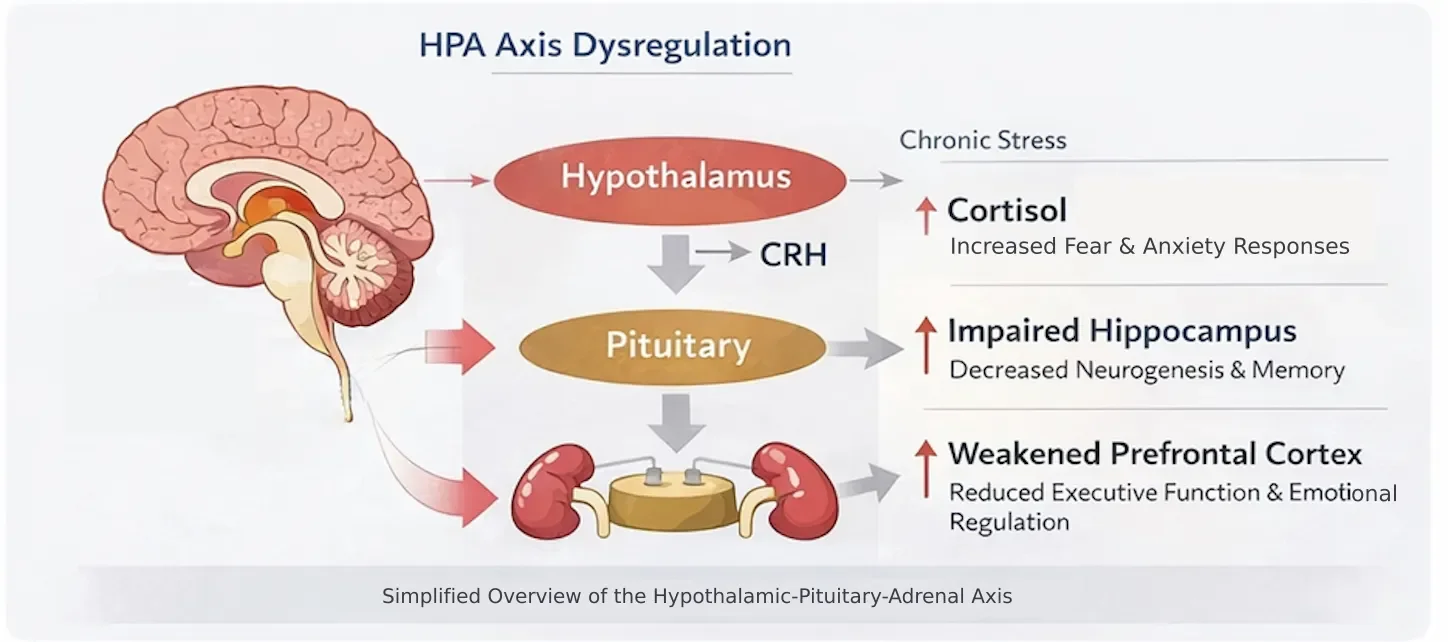
Press enter or click to view image in full size
These changes are not pathological by default; they are adaptive recalibrations in response to environments characterized by unpredictability or threat.¹,² Hypervigilance, emotional compartmentalization, and rapid threat appraisal are learned efficiencies.
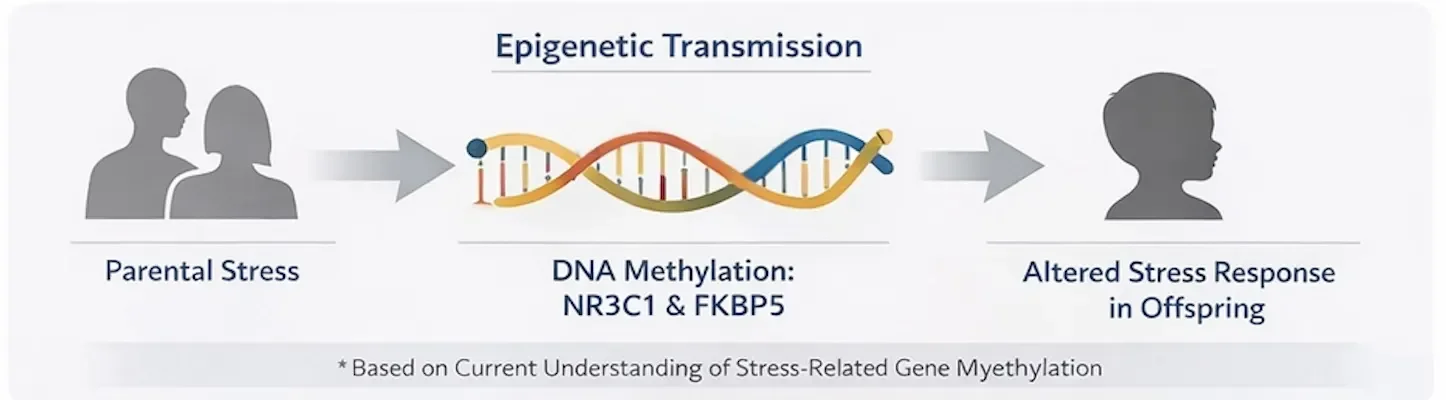
Generational trauma emerges when these adaptations extend beyond the individual. Epigenetic mechanisms, including DNA methylation of stress-related genes such as NR3C1 and FKBP5, influence how stress responses are regulated in subsequent generations.⁵–⁷ Human and animal studies consistently demonstrate that parental stress exposure correlates with altered HPA axis dynamics, amygdalar reactivity, and prefrontal-limbic connectivity in offspring.⁵–⁷
The Part You’re Really Here For: The Family Tea
Generation I: World War II
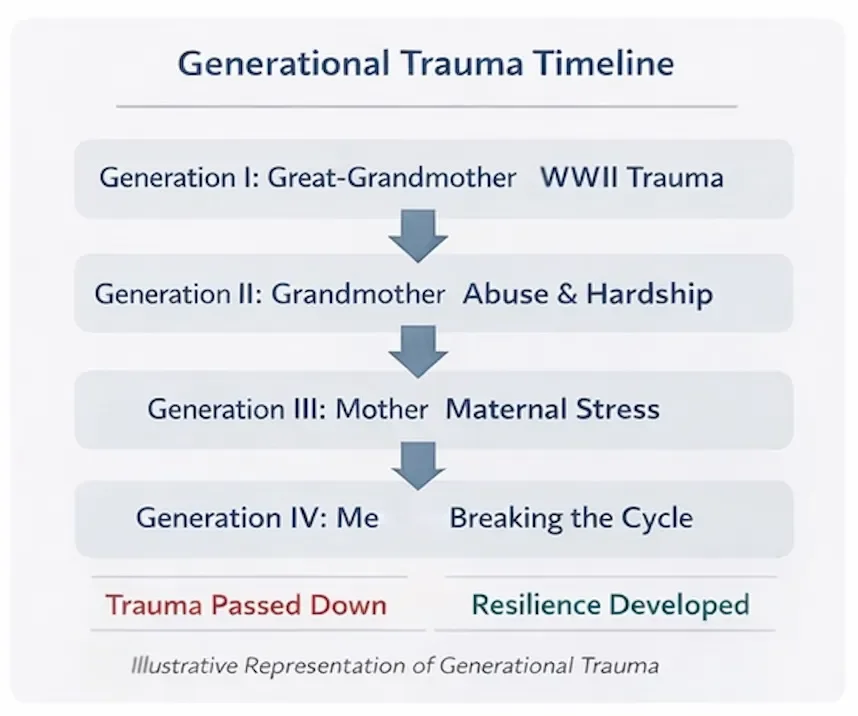
By the time I met my great-grandmother, she was already seventy years old. According to those who had known her longer, I never truly met her at all. I was told repeatedly that I had not seen what she was capable of. For most of her life, I was informed, she was a savage. She is now ninety-six, and I understand why that assessment persists. As a teenager, I was genuinely irritated watching entire rooms of adults defer to her without hesitation. Everyone complied, always. I remember wondering why they were so afraid. For a time, I flirted with the idea of making a film about her life, before abandoning both the project and my brief delusions of becoming a filmmaker.
From the outside, she does not look traumatized. Rather, she appears to be the source of trauma. That interpretation is understandable, but incomplete.Trauma does not produce uniform outcomes — in some nervous systems, prolonged threat results in collapse or withdrawal; in others, it produces rigidity, dominance, and an exaggerated need for control. The behavior appears aggressive, but the underlying mechanism is defensive.
I do not know what it does to a twelve-year-old brain to grow up on a remote farm as World War II unfolds. I do not know what marrying a much older, combat-shaped man at nineteen does to the nervous system. What I can explainis how sustained exposure to threat during development shapes stress-response systems. As we previously discussed, under chronic stress, the amygdala becomes highly reactive. The prefrontal cortex learns that hesitation doesn’t pay off. Control becomes regulation, emotional severity becomes safety. Over time, these patterns solidify into what is labeled personality but is more accurately understood as adaptation. My great-grandmother was not made cruel by her circumstances; she was made efficient. And that efficiency set the tone for generations to come.
Generation II: Where Shit Really Hit the Fan
Anyone raised by an exceptionally rigid, emotionally inaccessible parent understands this intuitively: it does not produce stability. When rigidity is paired with economic scarcity and relational dysfunction, the outcome is dysregulation. Children respond predictably to environments that never felt safe. That was the household my grandmother and her brother grew up in.
My grandmother became pregnant with my mother at seventeen; social pressure dictated the rest. She married a man unprepared for adulthood before the pregnancy was visible. This was the late 1960s. What followed were years of sustained stress: abuse, financial instability, and eventual single motherhood after she left my grandfather and raised three children alone without any support (her mother decided that getting divorce was worse than continuing to be abused, which she later used as an excuse to not help with the kids whatsoever).
By adulthood, her nervous system had been calibrated by chronic threat. Not isolated trauma, but constant unpredictability. This bias toward hypervigilance mattered profoundly when pregnancy entered the picture. Maternal stress during pregnancy is not contained within the mother.⁸–¹⁰ Cortisol crosses the placenta.⁸,⁹ Placental signaling actively transmits stress states to the developing fetus. Elevated prenatal stress is associated with altered development of the fetal limbic system, particularly the amygdala and hippocampus. Newborns exposed to high maternal cortisol show heightened stress reactivity and reduced regulatory capacity from birth.⁹–¹¹ Longitudinal studies link prenatal stress exposure to increased anxiety, emotional dysregulation, and altered fear processing later in life. Epigenetic modifications affecting glucocorticoid receptor expression impair stress recovery.⁵–⁷
My mother was not born into a neutral nervous system. She inherited one already shaped by her mother’s lived environment. My grandmother passed down endurance, control, emotional containment. Her children grew a little safer, but still neurologically primed to treat instability as baseline. Which is precisely how trauma survives progress.
Generation III: Shoutout to My Mom
Was my childhood perfect? Absolutely not. Was it drastically different from my mother’s? Without question. And that distinction matters more than people realize, because generational trauma does not require the same environments to repeat itself. It only requires the same nervous system patterns.
My mom grew up fast. Too fast. She lived in a rundown house in a sketchy part of a town no one ever talks about, took on a parental role for her two younger siblings, and somehow managed to be an A-plus student through it all. On paper, that looks like strength, but in the brain, it often looks like early hyperfunction. When a child learns that stability depends on performance, the nervous system adapts by staying alert, organized, and tightly controlled.
By the time I came along, the circumstances had shifted. I did not grow up worrying about food or shelter. I had clean clothes, my own bedroom, and a house in the suburbs. My older siblings would tell the story a little differently, and they would not be wrong, but timing is important here; the brain develops in windows. By the time I was born, my family was no longer in survival mode, although my parents’ marriage was, to put it mildly, far from peaceful. There were fights, raised voices, financial stress, jobs lost and found. But the chaos was contained; we were not living inside a constant threat response. From a neurological perspective, that difference is enormous, because a nervous system can tolerate stress if it is not forced to treat it as danger.¹¹,¹²
My mom carried her own history into motherhood. A lifetime of being responsible, of holding it together, of swallowing emotion in favor of function. She loved deeply, but her love did not always come out soft. Emotional expression was not intuitive to her, because her brain had learned early on that feelings were something you managed privately, not something you risked openly.
She did not break the generational trauma cycle. That is not how this works, unfortunately. What she did do was slowing it down. She softened the impact and made it possible for a different kind of brain to develop in her children. I know this because I can feel the difference, I can trace the line. I can see where her endurance became my capacity for reflection instead of self-preservation. Had she ended up like one of her siblings, I would not be here writing this. Or rather, I wouldn’t be here at all.
She gave me something no one before her had: enough safety for developing self-awareness. And sometimes, that is the catalyst for breaking the cycle. For that, I will never be able to thank her enough.
Generation IV: Yours Truly
I do not enjoy writing about myself. Not because I lack insight, but because honest self-examination is rarely flattering and never comfortable. Still, this part is necessary. If generational trauma ended with my siblings and me, then the brain in which it ended deserves scrutiny.
For nearly a decade, my nervous system lived in a state of poor regulation. Eating disorders, insomnia, depression, post traumatic stress disorder, and suicidal ideation were the background noise of my daily life. At the time, I did not understand why my mind behaved the way it did, and I internalized that confusion as self hatred. I kept engaging in self destructive behaviors, then went to bed each night asking myself the same question with growing desperation: why can’t I just be normal. I am grateful now that I never was; by the end of this section, that will make sense.
For years, I was terrified of repeating my aunt’s life. She was the youngest sibling, just like me, and uncomfortably familiar in ways I could not ignore. We shared personality traits, coping styles, and emotional reflexes. In my early adulthood, I watched myself reenact her patterns with unsettling precision, and eventually reached a point where denial was no longer possible. A few years ago, I went to therapy and stayed, even when it was deeply uncomfortable. The work brought nights of panic, grief, exhaustion. But it also taught me something crucial: the behaviors that once kept me alive were not permanent. My brain was not broken; it was adaptable.¹²,¹³
Learning about neuroplasticity changed everything. Understanding that the nervous system is shaped by experience and can be reshaped through sustained, intentional intervention gave me language for what I was already living through.¹²,¹³ I couldn’t erase the past, but I could recognize my response to it.
I still carry the past with me, and at times it resurfaces. But I no longer see it as evidence of weakness. It is the reason I developed the capacity to do the work healing requires. Without what I endured, I would not have pursued neuroscience with this level of obsession or conviction. I would not believe, with absolute certainty, that becoming a neurosurgeon is possible despite the odds. Most importantly, I would not have recognized that generational trauma was handed to me, or understood that breaking it was my responsibility.
Generational Trauma Can End With You, Too
Generational trauma is not some mystical family curse handed down at birth; it is repetition with good branding. It is biology doing exactly what it was trained to do, over and over again, until someone finally decides to interfere. Brains inherit patterns, not prophecies and patterns only feel inevitable until they are named.⁵,⁶,¹²
Healing does not feel good at first. To a nervous system raised on chaos, neglect, or control, stability feels suspicious. Regulation feels boring at best and unsafe at worst, while growth registers as loss. That discomfort is your brain protesting the removal of a familiar prison.
Ending generational trauma does not require villainizing your parents or romanticizing your pain. It requires responsibility. Responsibility for how you regulate, how you attach, how you respond when your nervous system drops into its default mode. When one person learns to do that differently, it is possible for the chain to break.
If you are reading this and recognizing yourself uncomfortably clearly, congratulations. You are self-aware. And awareness is interruption. Which means you’re capable of letting neuroscience do what it does best: prove that cycles end the moment someone decides not to repeat them.¹²
***
References
McEwen BS. Stress, adaptation, and disease: Allostasis and allostatic load. Ann N Y Acad Sci. 1998;840:33–44. doi:10.1111/j.1749‑6632.1998.tb09546.x
Lupien SJ, McEwen BS, Gunnar MR, Heim C. Effects of stress throughout the lifespan on the brain, behaviour and cognition. Nat Rev Neurosci.2009;10(6):434–445. doi:10.1038/nrn2639
Teicher MH, Samson JA. Annual research review: Enduring neurobiological effects of childhood abuse and neglect. J Child Psychol Psychiatry. 2016;57(3):241–266. doi:10.1111/jcpp.12407
Arnsten AFT. Stress signalling pathways that impair prefrontal cortex structure and function. Nat Rev Neurosci.2009;10(6):410–422. doi:10.1038/nrn2648
Meaney MJ, Szyf M. Maternal care as a model for experience‑dependent chromatin plasticity? Trends Neurosci.2005;28(9):456–463. doi:10.1016/j.tins.2005.07.006
Yehuda R, Bierer LM. Transgenerational transmission of cortisol and PTSD risk. Prog Brain Res. 2008;167:121–135. doi:10.1016/S0079‑6123(07)67008‑3
Yehuda R, Daskalakis NP, Bierer LM, et al. Holocaust exposure induced intergenerational effects on FKBP5 methylation. Biol Psychiatry.2016;80(5):372–380. doi:10.1016/j.biopsych.2016.02.033
Monk C, Spicer J, Champagne FA. Linking prenatal maternal adversity to developmental outcomes in infants. Biol Psychiatry. 2012;71(9):760–766. doi:10.1016/j.biopsych.2011.12.017
Van den Bergh BRH, Mulder EJH, Mennes M, Glover V. Antenatal maternal anxiety and stress and the neurobehavioural development of the fetus and child. Neurosci Biobehav Rev. 2005;29(2):237–258. doi:10.1016/j.neubiorev.2004.10.007
O’Donnell KJ, Meaney MJ. Fetal origins of mental health: The developmental origins of health and disease hypothesis. Am J Psychiatry.2017;174(4):319–328. doi:10.1176/appi.ajp.2016.16030353
Gunnar MR, Quevedo KM. The neurobiology of stress and development. Annu Rev Psychol. 2007;58:145–173. doi:10.1146/annurev.psych.58.110405.085605
Davidson RJ, McEwen BS. Social influences on neuroplasticity: Stress and interventions to promote well‑being. Nat Neurosci. 2012;15(5):689–695. doi:10.1038/nn.3093
Kandel ER. The biology of memory: A forty‑year perspective. J Neurosci.2009;29(41):12748–12756. doi:10.1523/JNEUROSCI.3575‑09.2009